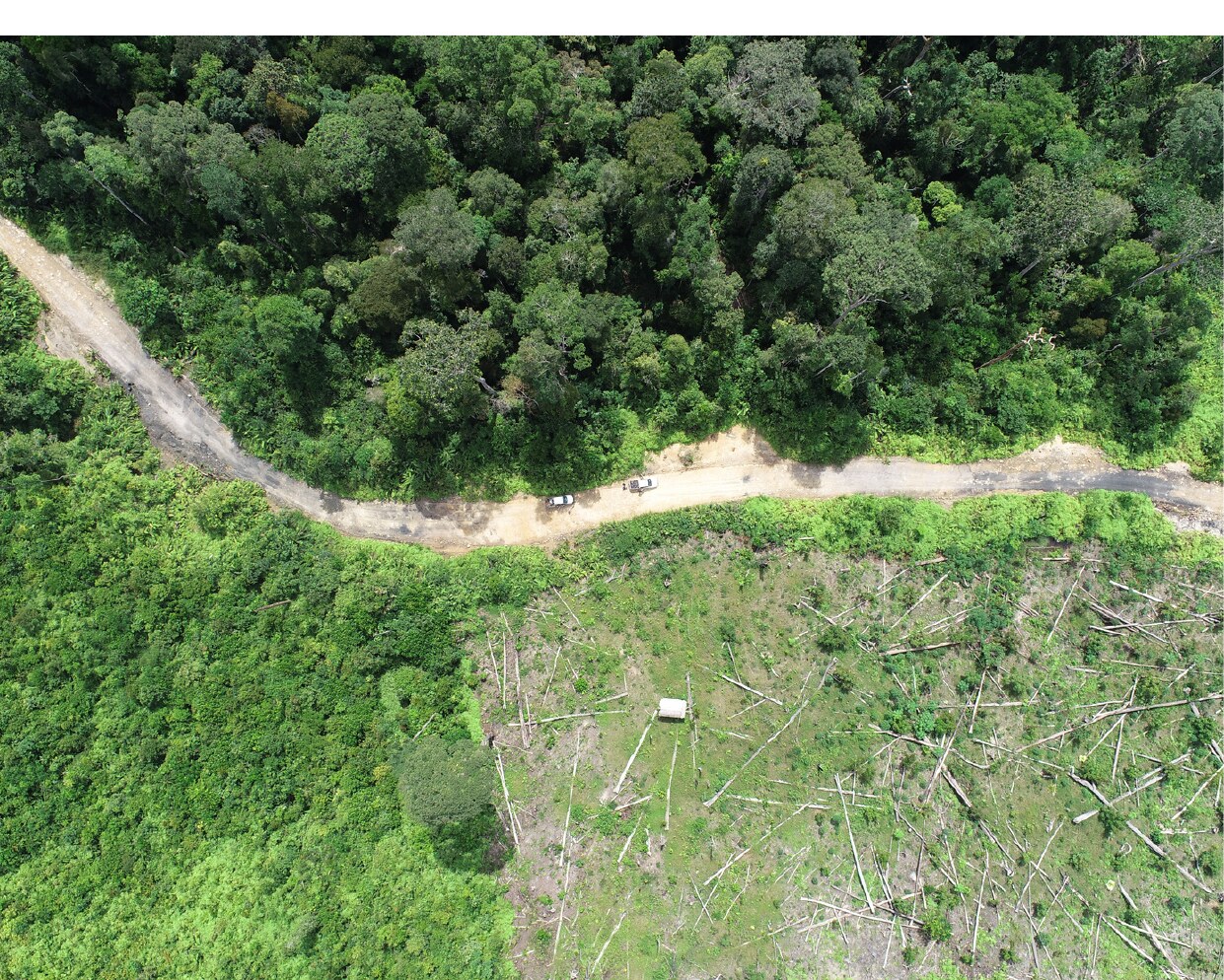
Karya Delta Permai
Nature-Based Solution
An 85,950 ha forest concession in Murung Raya, Central Kalimantan — restoring degraded land, preventing unplanned deforestation, and reducing logging impact inside the Heart of Borneo.
114°03'00"–114°30'00" E · 0°11'00"–0°33'00" S · MenLHK Concession Decree
85,950 ha
Concession Area
22.19M
tCO2e Total Reduction
25 yrs
Crediting Period
887,480
tCO2e Annual Average
A Forest Estate in the Heart of Borneo
The PT Karya Delta Permai (KDP) concession lies in Murung Raya Regency, Central Kalimantan — part of the Heart of Borneo conservation area at the headwaters of the Barito River, where the Müller-Schwaner mountains rise across the northern landscape.
The 85,950 ha forest estate was established under Ministry of Environment & Forestry Decree No. SK.89/MENLHK/SETJEN/HPL.0/1/2022, spanning production, limited production, conversion, protection, and sanctuary forest functions (APL, HP, HPT, HPK, HL, KSA/KPA).
The concession sits on mineral soil ecosystems dominated by dystropepts and tropudults, with hill-dominated topography characteristic of upper Murung Raya.
KALYRA's mitigation actions across the concession combine reforestation, prevention of unplanned deforestation, and Reduced Impact Logging–Carbon (RIL-C) — a 25-year programme designed to make conservation economically viable for the region.
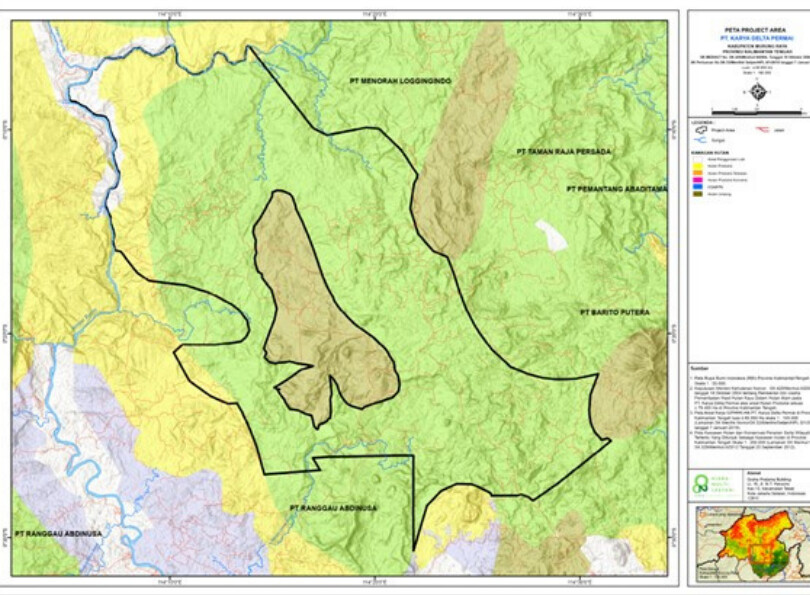
Peta project area — PT Karya Delta Permai · Source: Kiara Multi Lestari project booklet (July 2024)
Forest Function Zones
- Area Penggunaan Lain (APL)
- Hutan Produksi (HP)
- Hutan Produksi Terbatas (HPT)
- Hutan Produksi Konversi (HPK)
- Hutan Lindung (HL)
- Kawasan Suaka Alam / Kawasan Pelestarian Alam (KSA/KPA)
Location Overview
Geographically located at 114°03'00"–114°30'00" East and 0°11'00"–0°33'00" South, the area is dominated by hilly topography within the Barito River basin. The Müller-Schwaner mountains in northern Murung Raya form the headwaters of the Barito, placing the concession inside the world-renowned Heart of Borneo conservation landscape.
Emission Reductions Over 25 yrs of Crediting
Across the 25-year crediting period, the KDP programme is estimated to deliver a total greenhouse gas emission reduction of 22,186,994.08 tCO2e — 19,660,823.06 tCO2e from reforestation activities and 2,526,171.02 tCO2e from preventing unplanned deforestation, with zero leakage emissions.
RIL-C harvesting operations delivered an estimated emission reduction of 57,537.43 tCO2e in 2023, the first full year of implementation.
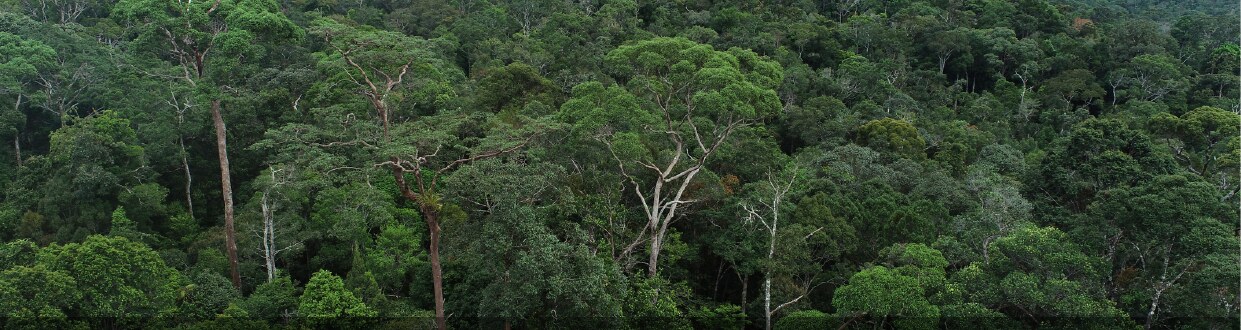
RKT 2024 planting blocks, PT Karya Delta Permai © Roland / KML
22,186,994
tCO2e Total Reduction
19,660,823
tCO2e Reforestation
2,526,171
tCO2e Avoided Deforestation
57,537
tCO2e RIL-C (2023)
AR-ACM 003 (CDM)
Reforestation & planting activities
MSAH001 (Dirjen PPI)
Prevention of unplanned deforestation
SRN Indonesia
Registered with the National Registry System
Estimated Annual Emission Reductions (tCO2e)
| Year | Reforestation | Avoided Deforestation | Total |
|---|---|---|---|
| 1 | 2,848.63 | 146,688.26 | 149,536.89 |
| 2 | 10,307.88 | 142,884.81 | 153,192.69 |
| 3 | 21,786.19 | 139,081.36 | 160,867.55 |
| 25 | 1,857,680.98 | 55,405.42 | 1,913,086.40 |
| Annual avg. | 786,432.92 | 101,046.84 | 887,480 |
Selected years from the project booklet (Table 1); reductions ramp up as planting cohorts mature. Leakage emissions are estimated at zero throughout.
A Refuge for Borneo's Rare & Threatened Species
Exploration and inventory surveys recorded 341 plant species dominated by Dipterocarpaceae, alongside 43 understory species — and a fauna assemblage of 18 mammal, 69 avifauna, and 52 reptile species.
The concession holds High Conservation Values 1, 2, and 3: areas of significant biodiversity, large landscape-level ecological processes, and rare or threatened ecosystems — including the rare Pendreh (PDH) ecoregion class found across the Beriwit, Luang, Mantalat, Maput, Pakalunai, Pendreh, Tandur, and Tewai Baru ecoregions.
18
Mammal Species
69
Avifauna Species
341
Plant Species
IUCN Red List Flora
Vatica venulosa
Agathis borneensis, Heliciopsis lanceolata, Madhuca elmeri
- Shorea laevis Ridl.
- Hopea myrtifolia
- Vatica paciflora
- Durio graveolens Becc.
- Ctenolophon parvifolius
- Cotylelobium lanceolatum
- Shorea mecistopteryx Ridl.
- Durio kutejensis
- Artocarpus anisophyllus
- Dipterocarpus crinitus
- Eusideroxylon zwageri
- Shorea smithiana Symington
- Artocarpus tamaran Becc.
- Beilschmiedia rivularis Kosterm.
- Dipterocarpus gracilis Blume
- Durio acutifolius (Mast.) Kosterm.
- Parkia singularis subsp. borneensis H.C. Hopkins
- Sandoricum koetjape (Burm.f.) Merr.
- Shorea atrinervosa Symington
- Sindora galedupa Prain
- Vatica sarawakensis F. Heim.
- Hopea mengarawan Miq.
- Saurauia bracteosa
- Gonystylus affinis Radlk.
- Knema korthalsii Warb.
- Xylopia coriifolia
- Madhuca sericea (Miq.) S. Moore
- Hopea pachycarpa (Heim) Sym.
- Durio dulcis Becc.
- Tetramerista glabra Miq.
34 species are classified as threatened on the IUCN Red List.
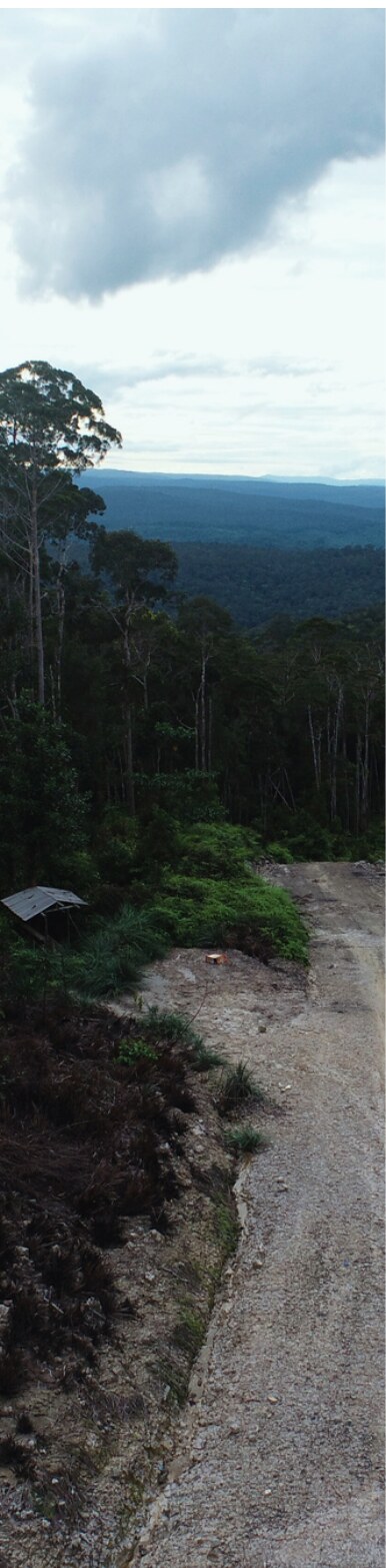
Ujung Pandang ridge line © Roland / KML
Survey teams also recorded Nyctixalus pictus frogs, Anthracoceros malayanus hornbills, sun bear tracks, and Hebius flavifrons snakes — evidence of a functioning forest ecosystem. Local communities were also found hunting within the project area, including primates caught with snares, underscoring the need for continued anti-poaching patrols.
Species of Conservation Concern
| Group | Species | Scientific Name | IUCN |
|---|---|---|---|
| Bird | Sempidan Merah | Lophura erythrophthalma | CR |
| Mammal | Owa Kalimantan | Hylobates muelleri | EN |
| Mammal | Monyet Ekor Panjang | Macaca fascicularis | EN |
| Mammal | Beruk | Macaca nemestrina | EN |
| Bird | Cica-daun Besar | Chloropsis sonnerati | EN |
| Mammal | Lutung Kelabu | Trachypithecus cristatus | VU |
| Mammal | Beruang Madu | Helarctos malayanus | VU |
| Mammal | Rusa unicolor | Rusa unicolor | VU |
| Mammal | Tarsius | Cephalopachus bancanus | VU |
| Mammal | Surili Dahi Putih | Presbytis frontata | VU |
| Bird | Kangkareng Hitam | Anthracoceros malayanus | VU |
| Bird | Rangkong Badak | Buceros rhinoceros borneoensis | VU |
| Bird | Julang Emas | Rhyticeros undulatus | VU |
| Bird | Tiong-batu Kalimantan | Pityriasis gymnocephala | VU |
| Bird | Bubut Teragop | Centropus rectunguis | VU |
| Reptile | Asian Softshell Turtle | Amyda cartilaginea | VU |
| Amphibian | Gunther's Borneo Frog | Meristogenys jerboa | VU |
High Conservation Values
HCV 1 — Biodiversity
Areas supporting significant biodiversity: habitat-providing areas (NKT 1.1), rare, threatened & endangered species (NKT 1.2), and viable populations of restricted-range species (NKT 1.3).
NKT 1.1–1.3 Present · NKT 1.4 Not found
HCV 2 — Landscape-level Processes
Large natural landscapes with capacity to maintain ecological processes (NKT 2.1) and representative natural species populations (NKT 2.3); contiguous multi-ecosystem mosaics (NKT 2.2) were not identified.
NKT 2.1 & 2.3 Present · NKT 2.2 Not found
HCV 3 — Rare Ecosystems
Rare and threatened ecosystems across nine ecoregion classes — Beriwit (BRW), Luang (LNG), Mantalat (MTL), Maput (MPT), Pakalunai (PLN), Pendreh (PDH), Tandur (TDR), and Tewai Baru (TWB) — including the rare Pendreh (PDH) class.
Present
Watersheds, Livelihoods & Living Heritage
The concession holds High Conservation Values 4, 5, and 6 — community services, basic needs, and traditional culture that anchor KALYRA's community partnership model.
Gunung Bondang
A critical water-catchment highland providing the springs and water sources for surrounding communities (HCV 4 & 5).
Hutan Ulin Desa Takajung
A village Ulin ironwood forest protecting against erosion and sustaining traditional customary agriculture (HCV 4 & 5).
Patung Patugur
A sacred statue at the peak of the Wara ritual, guiding Kaharingan ancestral spirits to heaven. A 100 m radius around the statue must remain free of damaging activity (HCV 6).

Desa Muara Jolo 1, on the Barito river © Roland / KML
Known Threats & Mitigation
Social studies identified illegal logging and illegal mining practices in villages across the concession — threats the project actively mitigates through protection patrols and alternative livelihoods.
Transparent Risks, Clear Mitigation
Risk analysis is included so the project owner fully considers and articulates project risks in a clear and transparent way — together with the proposed mitigations and their timing.
Lack of secure continuing financial resources until the project reaches cumulative break-even cash flow.
Secure external funding sources to carry the project through to cumulative cash-flow break-even.
Reduced liquidity or financial resources due to price variation of harvested timber.
Secure external funding sources to buffer timber price variation.
Climate change: prolonged dry seasons, rainfall variability, and water availability.
SOPs for climate-risk mitigation covering drought, rainfall variability, and water availability.
Exploitation of natural resources through illegal mining.
SOPs for handling illegal gold mining to prevent its spread across the concession.
Delay in reaching the project’s cumulative cash-flow break-even point.
Financial sensitivity analysis on inputs with the greatest influence on the break-even point.
Damage caused by forest fires.
SOPs for forest fire prevention and control.
Pests and diseases.
Pest and disease control and monitoring in line with company SOPs.
Project failure due to competing commodities (oil palm, soybean, mining).
Actions to re-confirm operating permits for the three mining companies, as satellite imagery has not yet shown on-the-ground activity within the KDP PBPH.
A Viable Conservation Economy
Projected net cash flow of Rp 1,173,260,248,610 over the remaining licence period. With a benefit-cost ratio well above 1 and the strongest payback of the KALYRA portfolio, the KDP carbon programme is economically viable.
54.62%
IRR
2.48
Benefit-Cost Ratio
3 years
Payback Period
Rp 1.17 trillion
Projected Net Cash Flow
Contributing to the Global Goals
The programme contributes to the United Nations Sustainable Development Goals through local employment, education, gender equality, community funds, climate action, and ecosystem restoration.
No Poverty
Employment opportunities for local communities across project implementation, coordination, and monitoring activities.
Quality Education
Workers and community members gain education and training through project field activities.
Gender Equality
Social equality through mainstreaming gender across all project activities, free from discrimination.
Decent Work & Economic Growth
Improved community welfare through the Community Clean Land Fund (PLKC) managed by communities around the forest.
Climate Action
Reducing greenhouse gas emissions while improving ecological quality through environmental education and awareness.
Life on Land
Restoring ecosystems and wildlife habitat through sustainable forest management, improving the quality and quantity of vegetation.
Partner With Us for
Lasting Climate Impact.
The market is moving beyond volume. Leading organizations increasingly prioritize high integrity, transparency, community outcomes, and biodiversity co-benefits. KALYRA is being developed with these expectations in mind.